



“Healthcare is in a state of disruption. In an industry being disrupted, experience can be a liability. We need to think about healthcare differently. Old solutions to new problems is a bad combination.”
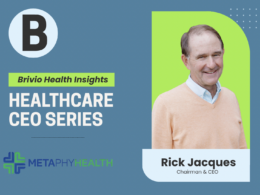
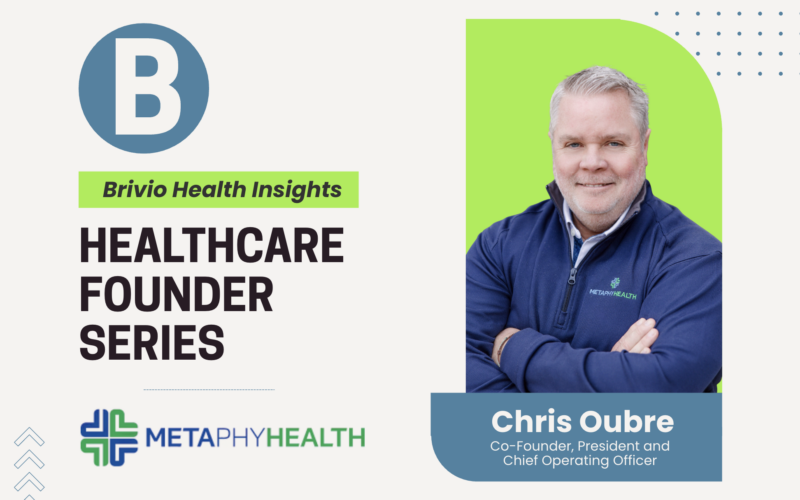
As part of our Brivio Health Insights: Healthcare Leadership Series, we sat down with Christopher Oubre, co-founder of MetaPhy Health, a virtual chronic care management company redefining what it means to support patients with complex, long-term conditions.
Rather than building another app or algorithm to monitor disease, Chris and his team built something healthcare had long overlooked: a services-first model that combines deeply trained clinical staff with technology to give patients the personalized accountability and education their conditions demand. His story is a compelling reminder that solving healthcare’s hardest problems sometimes requires setting aside conventional healthtech thinking entirely.
The Interview
Leadership Context
Let’s start at the beginning. What problem compelled you to build MetaPhy Health?
In 2017, my business partner Rick Jacques and I became acutely aware of the scale of the chronic disease crisis in the U.S., particularly for older patients. At the time, there were 45 million Medicare beneficiaries, a number projected to grow to nearly 80 million by 2030. Nearly 79% of adults over 65 were living with multiple chronic conditions: obesity, heart disease, diabetes, high blood pressure, high cholesterol. And close to 90% of all U.S. healthcare spending was tied to chronic disease.
This wasn’t just a significant problem. It was an accelerating one. And it wasn’t being solved.
Why were existing approaches falling short?
Most of what we saw in the market was focused on two things: diagnosing chronic disease and then layering in technology (apps, algorithms, AI) to address it. The problem is that diagnosis and monitoring alone don’t change outcomes.
I think about it like those old LifeLock commercials. There’s a bank robbery in progress, and the security officer’s response to the customer is, “I’m not a security guard, I’m a security monitor. I’m just here to let you know when you have a problem.” And then: “By the way, you have a problem.”
That’s what we kept seeing in healthtech. Sophisticated tools telling patients something was wrong, without the infrastructure to actually help them change it.
What was the moment you moved from “someone should solve this” to “we have to be the ones to do it”?
It happened through a series of deep conversations with physicians we’d worked with over the years. One in particular stands out: a lengthy conversation with Dr. Reed Hogan, one of the leading gastroenterologists in the country. That meeting was supposed to be 30 minutes. It lasted the entire day.
What crystallized for us in that conversation was twofold: first, that this was a problem physicians genuinely couldn’t solve on their own within the constraints of a traditional practice environment; and second, that the solution had to be rooted in services. The human element wasn’t optional. It was the point.
Strategic Priorities
Tell us about MetaPhy Health’s solution. What does it actually do?
We are, very specifically, a services company that leverages technology. Our model provides personalized patient experience, education, and accountability to help patients manage their chronic conditions.
The distinction matters. Technology is a tool in our hands, not the answer unto itself. What makes our solution different is the combination of a highly trained, highly engaged clinical team with state-of-the-art technology deployed in a variety of ways to meet patients where they are. The result is an exceptional virtual care experience that patients actually stay engaged with.
Who benefits beyond the patients themselves?
We think about our business in terms of clients and customers. Our customers are the patients we serve. Our clients are the physician practices we partner with on their behalf.
For physician practices, MetaPhy delivers on three dimensions. Clinically, it supplements the care they’re already providing in ways that improve patient outcomes. Operationally, it’s non-disruptive: practices don’t need to hire additional staff or implement new technology, because we bring everything. And financially, it functions as a meaningful ancillary revenue source while simultaneously contributing to system-wide savings.
It’s a model designed to work for everyone in the ecosystem.
Impact and Results
What outcomes have you seen?
The data is meaningful. Studies show the average annual healthcare cost for older patients managing multiple chronic conditions is roughly $50,000 per year. Programs like ours are demonstrating savings of 10 to 15% annually above and beyond the cost of the program itself, real financial relief on a system under enormous strain.
But what I find most compelling is the patient-level data. Each month, 7 to 10% of patients who exit our program do so because they’ve graduated, meaning they’ve improved to the point that they no longer qualify for chronic care management. They’re better.
On the experience side: 98% of our patients say their care coordinator genuinely cares about their wellbeing. 94% find the education and advice they receive helpful. And 89% give the program a Net Promoter Score of 8 to 10. In healthcare, those numbers are rare.
Leadership Philosophy
What principles have guided how you’ve built your team and company culture?
There’s a story I come back to often. A man comes upon a construction site and asks three workers what they’re doing. The first says, “I’m laying bricks.” The second says, “I’m building a wall.” The third stops, looks up, and says, “I’m building a cathedral.”
That’s the culture we’ve tried to create at MetaPhy. We want every person on our team to understand that what they’re doing day to day connects to something much larger: a mission to fundamentally change how patients with chronic conditions experience care. When people feel that connection, the work changes. The effort changes.
We also talk about the three P’s at the center of our business: Physicians, Patients, and our People. On the people side, getting the right individuals in the right roles has been critical. This work requires a particular kind of commitment, and the people who do it best understand why it matters.
Is there a piece of conventional wisdom in healthtech that you think needs to be challenged?
Healthcare is in the middle of a real disruption. A good friend of mine puts it well: in an industry being disrupted, experience can be a liability. The instinct is to reach for familiar frameworks and proven playbooks. But old solutions applied to new problems is a dangerous combination. We have to be willing to think differently, even when, especially when, it’s uncomfortable.
What do you wish more healthcare leaders understood about the problem you’re solving?
That the chronic disease crisis in this country is a human problem, and it requires a human-centered response. The patients we serve aren’t data points to be monitored. They’re people who need ongoing support, education, and someone in their corner. When we build solutions that recognize that, outcomes follow.
Looking Forward
What’s your vision for what MetaPhy can change in healthcare over the next decade?
Three things I’d like to see shift fundamentally.
First, that chronic care becomes proactive rather than reactive and episodic. The current model waits for things to go wrong. We should be ahead of it.
Second, that physicians gain continuous, longitudinal visibility into their patients’ status rather than relying on a snapshot from the last appointment.
And third, that patients feel supported between visits. That gap between clinical touchpoints is where so much can go wrong, and it’s exactly where we operate.
Christopher Oubre is the co-founder of MetaPhy Health, a virtual chronic care management company serving Medicare patients through physician practice partnerships. Learn more at metaphyhealth.com or connect with Chris on LinkedIn.
This interview is part of the Brivio Health Insights: Healthcare Leadership Series, a collection of in-depth conversations with the entrepreneurs and innovators shaping the business of healthcare.