



“We are harnessing AI to assist the life sciences vertical, so Medical and Scientific Affairs teams can focus on what matters most: supporting patients.”
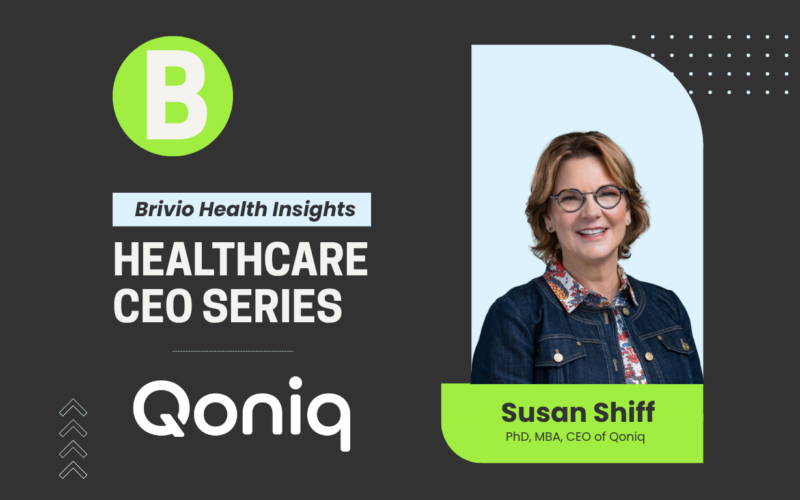
As part of our Brivio Health Insights: Leadership Series, we sat down with Susan Shiff, PhD, MBA, CEO of Qoniq, an AI-enabled technology solutions and services company purpose-built for Medical and Scientific Affairs and Communications teams in life sciences. Susan brings a rare combination of scientific rigor and strategic leadership to one of healthcare’s most consequential challenges: helping highly regulated organizations adopt AI-enabled technologies in ways that are defensible, transparent, and genuinely useful. Her perspective on what it takes to lead at the intersection of innovation and institutional trust is one every healthcare executive navigating AI adoption should hear.
What is the most significant strategic challenge your organization is currently navigating?
Building the confidence and trust that allows clients to adopt AI-enabled technologies in a setting where their credibility, scientific reputation, and regulatory exposure cannot be ignored. The Life Sciences industry is heavily regulated, and technical innovation moves faster than most organizations can comfortably absorb. Many of our clients are working through how to integrate AI appropriately into existing workflows. Our approach is hands-on by design: we make sure Qoniq’s systems meet their rigorous standards and remain transparent and scientific throughout.
What conventional approach or industry assumption have you chosen to challenge, and why?
The default assumption that general-purpose AI can adequately serve Medical and Scientific Affairs. It cannot. Medical Affairs colleagues are managing massive volumes of fragmented data and need to rapidly surface patterns, connections, and insights that would be nearly impossible to uncover manually. General-purpose AI tools are not built for the complexity or scientific rigour required.
Qoniq combines AI-enabled systems and workflows with expert guidance to help life science organizations transform that volume of information into novel insights, defensible scientific understanding, and well-sourced and documented reports. The combination of purpose-built technology and domain expertise is what makes the difference.
What constraints or trade-offs have shaped your strategic decisions most significantly?
The decision to focus exclusively on Medical and Scientific Affairs and Communications organizations in Life Sciences rather than trying to serve a broader market. That kind of focus means saying no to adjacent opportunities. But it also means our solutions and expertise fit these organizations precisely, and it gives us the ability to purpose-build for the future needs of Medical and Scientific Affairs teams specifically. Depth over breadth has been the deliberate trade-off, and we believe it is the correct one.
What measurable progress are you most proud of?
One client told us our reports equal the quality of the work of a PhD on their team. That type of validation, from scientists whose standards are exactly the ones we set out to meet, is the bar we hold ourselves to. When the people with the highest standards in your target market tell you that you have met them, that matters.
What has proven more difficult to change than you anticipated, and what have you learned from that?
How much foundational work would fall to us. Medical and Scientific Affairs teams are still developing their frameworks for evaluating AI tools, and many clients do not yet have the internal benchmarks or key performance indicators to measure what we deliver. Conversations with clients address both how our solutions and services can support their work, but also how we can help them define their success criteria.
The lesson is that we are not selling a product. We are helping shape how this entire category gets implemented and then measured. While the process takes more time than I anticipated, the result is the implementation of AI-enabled solutions that show measurable success for a client.
Beyond your organization’s direct mission, how is your work contributing to broader healthcare improvement?
Our work does not directly touch the patient, but it helps to ensure that they receive safe, effective diagnostics and treatments when they need them the most. I emphasize this at every team meeting to reinforce why our work matters.
What principles guide how you make decisions when there’s no clear right answer?
At Qoniq, we say we are sourced from science and driven by values. When there is no clear answer, I return to our five core values: lead with transparency and accountability; practice principled innovation; elevate human expertise; think strategically and adapt precisely; and build intelligence together. Those are not aspirational statements. They are the framework we use to navigate hard calls.
How does your team composition reflect the problem you’re solving?
The problems we solve are at the intersection of AI health technology and Medical and Scientific Affairs, so the team has to have credibility in both areas. We have professionals with deep backgrounds in the Life Sciences solutions and services spaces and in health technology and generative AI. This genuine understanding of the valuable work Medical and Scientific Affairs and Communications does on a daily basis allows us to focus on what matters the most to the clients we serve.
How do you think about building and empowering your leadership team?
I hire servant leaders and empower them to innovate, problem solve, and provide the highest quality of client focus and scientific output. Each leader owns the decisions in their area. What I have worked to build is the habit of surfacing issues and using all our resources to inform our work. No single function has the full picture. The best outcomes come when the people closest to each problem are also connected to the broader organization.
Susan Shiff, PhD, MBA, is the CEO of Qoniq, an AI-enabled solutions and services company serving Medical and Scientific Affairs and Communications teams in Life Sciences. Learn more at qoniq.com or connect with Susan on LinkedIn.
This interview is part of the Brivio Health Insights: Leadership Series, a collection of in-depth conversations with the executives and innovators shaping the business of healthcare.