



“Organizations don’t lack strategy; they lack execution capacity while still trying to run the business. So instead of leading with multi-year roadmaps or big implementations, we start with stabilization and outcomes. We put small, senior teams directly into the work, own results, and deliver value quickly.”
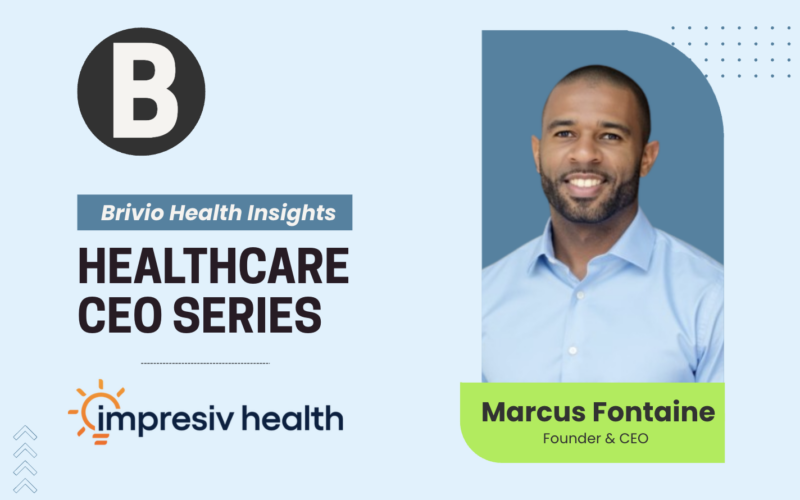
As part of our Brivio Health Insights: Healthcare CEO Series, we sat down with Marcus Fontaine, founder of Impresiv Health, to discuss how health plans can navigate today’s complex operational, financial, and regulatory pressures.
Marcus Fontaine is the Founder and CEO of Impresiv Health. Under his leadership, the firm has supported health plans and payer-aligned organizations nationwide in stabilizing UM/CM performance, strengthening delegated oversight, improving audit readiness, modernizing payer technology platforms, and developing sustainable staffing and workforce strategies.
Marcus and his team focus on translating strategy into execution, aligning people, process, technology, and data to improve quality, protect financial performance, and support compliant, high-value care delivery across Medicaid, Medicare Advantage, and commercial lines of business.
A systems thinker at heart, Marcus focuses on aligning people, process, technology, and data into practical operating models that work in real-world environments.
The Interview
Leadership Context
What is the most significant strategic challenge your organization is currently navigating?
On the market side, health plans are facing extreme pressure: tighter margins, heightened CMS scrutiny, rising medical costs, and ongoing technology transformation, and sometimes all at once. Many are trying to modernize care management platforms or operating models while still dealing with staffing shortages, leadership turnover, and day-to-day operational fires.
Operationally, the reality is that plans don’t just need strategy or software; they need execution capacity. They need teams that can step in quickly, protect quality and compliance, and drive measurable outcomes without adding long-term overhead.
Strategically, for us, that means staying laser-focused on speed to value: aligning clinical, operational, and technology expertise in a way that actually helps clients stabilize, modernize, and scale rather than layering on more complexity. The challenge is doing that in a market where urgency is high, timelines are compressed, and tolerance for disruption is low.
So our priority is building an organization that’s flexible, outcome-driven, and trusted enough to operate at the center of those transitions—especially when things aren’t perfectly defined.
What conventional approach or industry assumption have you chosen to challenge in addressing this, and why?
We’ve challenged the assumption that meaningful transformation in healthcare has to be slow, disruptive, and driven by massive programs.
What we kept seeing was that organizations didn’t lack strategy; they lacked execution capacity while still trying to run the business. So instead of leading with multi-year roadmaps or big implementations, we start with stabilization and outcomes. We put small, senior teams directly into the work, own results, and deliver value quickly.
That approach came from watching too many plans get stuck in over-engineered transformations while performance, compliance, and morale suffered. We believe transformation should be a byproduct of strong execution and not a pause in it.
What constraints or trade-offs have shaped your strategic decisions most significantly?
The biggest constraints shaping our strategy are regulatory pressure, margin compression, and the need to move fast without breaking trust.
In healthcare, especially with health plans, compliance and audit readiness aren’t optional—they set hard guardrails around how quickly and how aggressively change can happen. At the same time, clients are under intense cost pressure, which limits tolerance for long ramp-ups or abstract value.
That forces a trade-off for us: we have to prioritize speed and outcomes while staying disciplined about quality, clinical integrity, and risk. Strategically, that’s pushed us toward smaller, senior teams, tighter scopes, and clear accountability—because credibility and trust matter more than scale or volume in this environment.
Strategic Priorities
What specific organizational capabilities are you building or transforming right now?
We’re building execution muscle operationally, technically, and culturally so we can move fast, own outcomes, and operate credibly inside regulated environments.
How do you expect these changes to impact the future of the company?
In the near term, over the next year, these changes make us faster and more reliable.
Over the next three years, this positions us to scale intentionally.
And over five years, it fundamentally defines who we are.
What stakeholder dynamics most influence your strategic decisions, and how do you navigate competing priorities?
The key dynamic we manage is balancing clinical quality, client expectations, and regulatory accountability, often under real-time and cost pressure.
We navigate that by being explicit about trade-offs and anchoring decisions in outcomes that protect quality and compliance first. When there’s conflict, we default to clinical integrity and regulatory credibility, because trust is the foundation that allows everything else to move faster over time.
Impact and Results
What measurable progress has your organization made under your leadership that you’re most proud of?
What I’m most proud of recently is turning execution discipline into measurable outcomes.
Over the past year, we’ve shortened time-to-value on new engagements, reduced ramp-up time for clinical and technical resources, and improved client retention by focusing on outcomes instead of utilization. We’ve also expanded from primarily project-based work into repeatable managed services, which has improved margin stability and predictability.
Beyond your organization’s direct mission, how is your work contributing to broader healthcare improvement?
We’re helping make healthcare execution more sustainable and affordable. It becomes better for members and consumers, safer for clinicians, and more reliable for organizations by proving that disciplined execution beats the cost of complexity.
Leadership Philosophy
What principles guide how you make decisions when there’s no clear right answer?
I prioritize trust, outcomes, and integrity.
Then I decide, act, and adjust quickly rather than wait for perfect information.
Sometimes you just have to trust your gut over what every playbook will tell you to do.
How do you think about building and empowering your leadership team?
I hire leaders for judgment and ownership, set clear guardrails, and give them real authority because empowerment without accountability doesn’t work.
What do you want your organization to be known for in the healthcare industry?
I want us to be known as the partner health plans trust when execution really matters. When there is a problem, I want to be the first phone call.
Looking Forward
If your strategic vision succeeds, how will your organization have contributed to changing healthcare over the next 5-10 years?
Over the next five to ten years, I believe our contribution will be proving that health plans can modernize, stay compliant, and improve outcomes without burning out their workforce or disrupting members.
What’s one piece of conventional wisdom in healthcare or healthtech that you believe needs to be challenged?
One piece of conventional wisdom that needs to be challenged is the idea that better technology alone will fix healthcare.
What trend or shift in healthcare do you believe will become most important over the coming 18 months?
The most important shift over the next 18 months will be the move from AI experimentation to AI accountability, proof, and governance.
Marcus Fontaine is the founder of Impresiv Health, a company focused on helping health plans execute through complex operational, clinical, and regulatory challenges. Learn more at impresivhealth.com or connect with Marcus on LinkedIn.This interview is part of the Brivio Health Insights: Healthcare CEO Series, a collection of conversations with leaders shaping the future of healthcare.