


“As healthcare leaders are inundated with AI offerings, they need trusted partners who understand what is safe, effective, and appropriate for highly regulated healthcare use.”
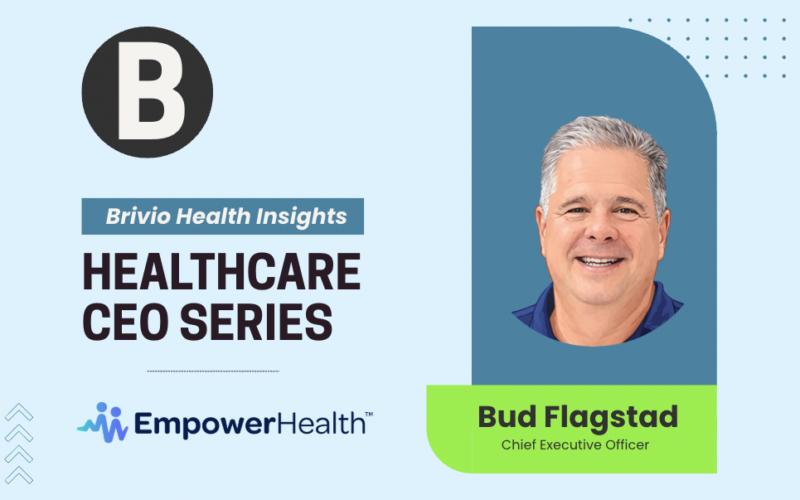
As part of our Brivio Health Insights: Healthcare CEO Series, we spoke with Bud Flagstad of EmpowerHealth, an organization pioneering healthcare conversational technology built on augmented intelligence. In a rapidly evolving AI landscape, Bud brings a pragmatic, compliance-first leadership approach, focused on helping healthcare organizations adopt the right technologies safely, effectively, and at scale.
The Interview
Your Leadership Context
What is the most significant strategic challenge your organization is currently navigating?:
As the healthcare industry increasingly accepts artificial intelligence (AI) and defines what their guardrails are across complex, regulated environments, it’s EmpowerHealth’s job to help organizations meet the needs of their members and patients responsibly. Our most significant strategic challenge and opportunity is helping health organizations cut through the growing AI landscape to adopt the right solutions with confidence. As healthcare leaders are inundated with AI offerings, they need trusted partners who understand what is safe, effective, and appropriate for highly regulated healthcare use.
Since 2014, EmpowerHealth has pioneered healthcare conversational technology built on augmented intelligence, where technology enhances, rather than replaces, human judgment. We have mastered machine learning in a way that delivers outcomes that rival AI without the inherent risk that unsupervised or generative models can introduce.
What conventional approach or industry assumption have you chosen to challenge in addressing this, and why?:
The assumption is that people will hang up when an AI virtual health assistant calls. The reality is different than that. Our engagement and activation rates are typically higher than human call center rates. It’s all how you communicate with the members to initiate the engagement, such as using white-labeled Caller ID. We also support synchronized, omnichannel engagement (e.g., voice, text, secure chat), so our clients can choose the modality or combination of modalities that best aligns with the needs and preferences of their specific population. Because of this, we see between 40% and 95% engagement depending on the use case. We find that members with a healthcare need, such as with a chronic condition or filling a prescription, are much more likely to engage.
What constraints or trade-offs have shaped your strategic decisions most significantly?:
Constantly evolving regulatory requirements in the healthcare industry are a clear example of a moving target. As a small company, we’re able to be nimble—we closely monitor regulatory changes and regularly update our product to ensure we meet those requirements, while protecting our clients and the best interest of their member base. We are HITRUST r2 certified, which is the most rigorous certification available, and we constantly monitor and comply with the Telephone Consumer Protection Act (TCPA) and PHI/PII requirements. This level of vigilance and investment comes at a significant cost, but it’s truly table stakes for operating in this industry.
Strategic Priorities
What specific organizational capabilities are you building or transforming right now?:
We are continually focused on how to make our solutions operationally efficient and effective. Being able to deploy our solution rapidly for our clients is especially important to us and to them. So, building a solution that allows for rapid deployment and validation is key to our success. Technologically, we are constantly scanning the market and implementing well-proven technologies that drive toward strategic goals for our client partners and our own organization. We are seeing a continued cultural acceptance of AI by both our clients and their members as AI becomes more ingrained in everyone’s daily lives.
How do you expect these changes to impact the future of the company? :
I believe we will see a step function increase in productivity with new tools and capabilities monthly over the next three to five years. This will enable us, as a nimble, quick-moving company, to continually evaluate and adopt those capabilities to meet the evolving demands of our clients and their members, while also adapting to the regulatory changes that come with them. Also, I believe we’ll see the emergence of tools that evaluate AI with AI, which will further shape and impact our business in the future.
What stakeholder dynamics most influence your strategic decisions, and how do you navigate competing priorities?:
Because EmpowerHealth’s leadership has over 75 years combined of healthcare knowledge, we understand the healthcare voice of the customer—not only payers and providers, but also members and patients. Our process is to keenly listen to our customers and guide them with our knowledge and experience, while at the same time understanding the business and regulatory challenges that they need to balance. Many of the solutions we build are based on customer need, and a significant part of the work we do in building our solutions is making sure it meets regulatory compliance. At the end of the day, our role is to align our expertise with our partners’ priorities to strengthen the healthcare system and improve the outcomes and experiences of the members and patients it serves.
Impact and Results
What measurable progress has your organization made under your leadership that you’re most proud of?:
I’m most proud of the measurable growth we’ve achieved over the past four years. During that time, our member outreach volumes have increased by more than 925%, while gross revenue has grown by nearly 400%. These results reflect the strength of our strategy and leadership, our focus on execution, and our ability to scale effectively while continuing to meet the needs of our customers and their members.
What has proven more difficult to change than you anticipated, and what have you learned from that?:
Because AI is still in its infancy within the healthcare industry, executing contracts, completing rigorous security assessments, and meeting internal AI governance requirements, especially with health plans and health systems, often extend sales cycles. We view this rigor as an important validation of our approach and are proud to consistently pass these reviews, reinforcing the strength, safety, and readiness of our solution.
At the same time, we are constantly looking at ways to evolve our approach and reduce the time from initial customer conversation to go live. As our customer base diversifies, we’ve also learned that timelines vary by organization, with startups and smaller health organizations moving more quickly, while larger, more regulated entities requiring additional internal review before member outreach can begin.
Beyond your organization’s direct mission, how is your work contributing to broader healthcare improvement?:
Beyond our direct mission to reinvent the health experience, one conversation at a time, our contributions show up in the real world impact our engagement and activation capabilities have on helping individuals live healthier lives. Whether it’s enrolling them in a key program to help manage a chronic condition, keeping prescriptions filled on a timely basis, or helping members better understand their benefits, our solutions drive meaningful impact. In many cases, our engagement scores are higher than traditional call center engagement and other outreach modalities our customers use to reach their member base.
At the same time, our solutions reduce the administrative burden on call center agents and care teams, often by hours per day per person, allowing them to focus on more complex member needs where a human in the loop is essential. For example, with one national health plan, we supported outreach to Medicare members with multiple chronic conditions to collect health metrics, close gaps in care, and address SDOH, saving each case management nurse three hours per shift so they could focus on members needing the highest level of care.
Leadership Philosophy
What principles guide how you make decisions when there’s no clear right answer?:
When there’s no clear right answer, I focus first on fully understanding the decision in front of us and the problem we’re really trying to solve. I break complex decisions into their core components, prioritize what matters most, and evaluate the options and tradeoffs for each part. In situations with imperfect information, we test assumptions wherever possible, learn quickly from results, and adapt our approach as needed. That combination of structured thinking, iteration, and accountability allows us to move forward confidently—even in uncertainty.
How does your team composition or approach reflect the problem you’re solving? :
Developing teams to support uncertainty and challenges, like running an early-stage company, requires finding the right people who can roll up their sleeves and play many roles. Most team members at EmpowerHealth have had experience working in large and small organizations—Fortune 5 to early-stage start-up. That experience allows us to anticipate challenges as well as develop risk mitigation strategies. Our team is built to move fast and solve problems rapidly.
How do you think about building and empowering your leadership team?:
Leadership experience combined with an extensive healthcare background, is tantamount to building an executive team in this industry. Understanding the challenges our clients deal with is key to creating solutions to meet their needs. Our executive leadership team has worked at all levels of the healthcare industry, within multiple segments of the industry, which gives us a practical, firsthand perspective. Often when we are on calls with clients, we can finish their sentences when we discuss their challenges. Good leadership inspires a great team!
What do you want your organization to be known for in the healthcare industry?:
I’d like EmpowerHealth to be known for creating the most effective health engagement solutions that leverage artificial/augmented intelligence, with the goal of making every interaction meaningful and impactful for our clients and their members and patients.
Looking Forward
If your strategic vision succeeds, how will your organization have contributed to changing healthcare over the next 5-10 years?:
We intend to be part of a growing number of healthcare conversations that leverage our AI virtual assistant to help members and patients live their healthiest lives possible, and we would view that as a remarkable success. That capability is already in place and continues to evolve as our technology is leveraged across more and more use cases. As a result, the millions of conversations we support annually continue to grow significantly, extending our impact across the healthcare ecosystem over time.
What’s one piece of conventional wisdom in healthcare or healthtech that you believe needs to be challenged?:
As I mentioned earlier, one widely held assumption that needs to be challenged is the belief that people won’t converse with an AI powered virtual health assistant. In reality, we see the opposite. Our engagement and activation rates are typically higher than traditional human call center rates. A lot of that comes down to how the engagement is initiated, using thoughtful communication strategies like white labeled Caller ID, and giving clients flexibility through synchronized omnichannel engagement, including voice, text, and HIPAA secure chat. This allows them to choose the modality, or combination of modalities, that best aligns with their population. As a result, we see engagement rates ranging from 40% to as high as 95% depending on the use case, especially among members with real healthcare needs such as managing chronic conditions or filling prescriptions.
What trend or shift in healthcare do you believe will become most important over the coming 18 months?:
The most important shift in healthcare over the next 18 months will be the rapid move from experimental pilots to enterprise-wide scaling of generative AI (Gen AI) and especially agentic AI. This isn’t just incremental tech adoption, it’s a foundational transformation that will drive efficiency, reduce administrative burdens, support clinical decision-making, enable more personalized and proactive care, and help address persistent cost and workforce pressures.
Bud Flagstad is the CEO of EmpowerHealth, a company focused on advancing augmented intelligence solutions that enhance patient engagement and improve healthcare outcomes. Learn more at empowerhealth.ai or connect with him on LinkedIn.
This interview is part of the Brivio Health Insights: Healthcare CEO Series, a collection of in-depth conversations with leaders shaping the future of healthcare.