



“I wanted to start this company for three reasons: to make a good living, to accomplish that in an honorable way, and to work with people I enjoyed. That’s really and truly my mission.”
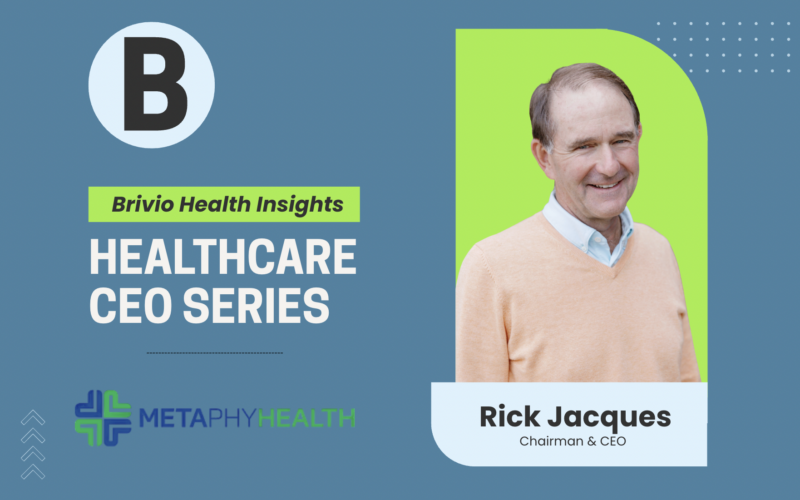
As part of our Brivio Health Insights: Healthcare CEO Series, we sat down with Rick Jacques, co-founder of MetaPhy Health, a virtual chronic care management company helping Medicare patients with chronic conditions live healthier, better-supported lives.
Rick brings more than 35 years of healthcare services experience to MetaPhy, having helped build some of the industry’s most significant physician-centered businesses along the way.
What sets Rick apart is his refreshing willingness to say what others won’t: about why he really started this company, what healthcare is actually missing, and why doing good work and making a good living aren’t mutually exclusive. His perspective is a counterpoint to the polished founder narrative, and all the more compelling for it.
Thank you for joining us, Rick. Let’s start at the beginning. What problem compelled you to build MetaPhy Health?
My business partner Chris Oubre and I had both spent decades in healthcare services when we started seeing the same problem from every angle: chronic disease was consuming the system, and nobody was really managing it. Close to 90% of U.S. healthcare spending was tied to chronic conditions. Nearly 79% of adults over 65 were living with multiple conditions at once. And the care model, built around episodic visits and reactive interventions, wasn’t built to handle any of it.
I remember talking to a vascular surgeon, one of the kindest people I know, about a patient whose mesenteric artery was 50% blocked. His response? He wasn’t going to do anything about it yet. He does surgery when people are about to die. That’s the system. It waits. And for patients with chronic illness, waiting is exactly the wrong approach.
Why were existing approaches falling short?
The system is episodic by design. You go to this kind of doctor, they fix that thing, and you leave. There’s no one focused on the whole patient, the lifestyle, the underlying conditions. Chronic disease, by its nature, doesn’t work that way. It accumulates. It compounds. And it’s largely lifestyle-driven: people not eating well, not exercising, struggling with motivation or depression or isolation.
Technology wasn’t solving it either. What most healthtech was offering amounted to sophisticated monitoring without meaningful intervention. Telling someone something is wrong is not the same as helping them change it.
What was the moment you moved from “someone should solve this” to “we have to be the ones to do it”?
Honestly, we stumbled into it. Chris and I were initially building a diagnostic company. We had a tool that could surface chronic conditions in patients. When we started presenting it to physicians, many of them pushed back. They didn’t want to know everything that was wrong with their patients if there was nothing they could do about it within the constraints of a traditional practice.
That forced us to ask a different question: what happens after the diagnosis? We started researching chronic care management, found that Medicare had developed reimbursement codes for exactly this kind of ongoing virtual support, and realized we had the background and the relationships to build something around it. We pivoted completely away from diagnostics and went all in on CCM. It wasn’t a lightning bolt moment. It was a pivot that made more sense the longer we looked at it.
Tell us about MetaPhy Health’s solution. What does it actually do?
We provide personalized virtual chronic care management to Medicare patients through their physician practices. Patients get their own dedicated care coordinator, a trained nurse who checks in regularly, spends real time with them, answers their questions, and helps them understand and manage their conditions. Not 10 minutes squeezed between appointments. Actual time.
We’ve built the technology, the clinical team, and the operational infrastructure so that physician practices don’t have to. They partner with us, their patients get better support, and the practice benefits financially without adding staff or complexity.
What outcomes have you seen?
The data tells part of the story. Average annual healthcare costs for Medicare patients with multiple chronic conditions run around $50,000. Programs like ours are generating savings of 10 to 15% annually above the program’s cost. And each month, 7 to 10% of patients exit because they’ve graduated, meaning their conditions have improved to the point they no longer qualify for chronic care management. They’re better.
But here’s what I think is more honest and more meaningful: if you look at 100 patients in a program like this, roughly half won’t engage meaningfully. They’ll drop out in a few months for any number of reasons. Another 10 to 15% will try, lose momentum, and eventually disengage. But about 35 to 40% will really commit. They’ll stay. They’ll improve. Some will graduate. And those patients’ lives change. That may not sound like a big enough number to some people, but to me, it’s extraordinary. We hear it in the testimonials. We see it in the surveys.
The experience scores reflect it too: 98% of our patients say their care coordinator genuinely cares about their wellbeing. 94% find the information they receive valuable. And 89% give the program a Net Promoter Score of 8 to 10.
Who benefits beyond the patients themselves?
We think about the business in terms of clients and customers. Our customers are the patients we serve. Our clients are the physician practices we partner with on their behalf.
For physician practices, MetaPhy delivers on three dimensions. Clinically, their patients are getting ongoing support that improves outcomes. Operationally, it’s non-disruptive: we bring the staff, the technology, and the process, so practices don’t have to change how they operate. And financially, it functions as a meaningful ancillary revenue source while reducing costs for the broader system.
Beyond that, I’d say our own clinical staff benefits too. These nurses get genuinely involved in their patients’ lives. They know their families. They care about them. That kind of work, doing something that matters for people who need it, makes an impact on the people doing it as well.
What principles have guided how you’ve built your team and company culture?
I’ll be frank about this, because I’m not much for corporate speak. I started this company to make a good living, to do it honorably, and to work with people I enjoy. That’s my actual mission. I’ve been transparent about it with the people who work here because I think people deserve honesty about why they’re being asked to show up every day.
What that means in practice is that we hired people we trusted from past chapters of our careers, people we knew had character, before we thought too hard about credentials or skillset. As a former football coach, another good coach once told me you can’t coach speed. I’d rather find the athlete and teach them the game, so to speak. If someone is honest, hardworking, humble, and loyal, we can teach them anything else they need. Character is not something you can train into people.
My personal motto is simple enough that I can remember it: trust God, persevere, do the right thing. We try to run the company that way.
What’s your vision for what MetaPhy can change in healthcare over the next decade?
I’ll be honest here, too, because I think founders often overstate this. I’m not trying to change the world. What I want is to keep helping patients one at a time, take care of the people who work here, and do it with integrity along the way.
Chronic care management has been around for about 10 years and is still gaining traction. Adoption of new care models takes time in healthcare. I saw the same pattern 35 years ago when physician-owned surgery centers were just getting started. But over time, this becomes standard practice.
Is there a piece of conventional wisdom in healthcare that you believe needs to be challenged?
The depersonalization of medicine. We’ve become so focused on efficiency, volume, and institutional scale that we’ve lost something essential: the relationship between a physician and a patient.
I think about the old country doctor with a black bag who knew his patients by name, knew their families, knew their lives. When was the last time you tried to call a doctor’s office and actually spoke to a real person? That’s what healthcare has become. And I think it’s one of the biggest failures of the modern system.
What we offer, a patient having their own nurse who has time for them, who listens, who remembers what they said last month, is a small attempt to restore something that’s been lost. Healthcare is personal. It’s relational. No amount of technology changes that fundamental truth.
What do you wish more healthcare leaders understood about the problem you’re solving?
Think about what a standard appointment actually looks like for a patient managing chronic conditions. Fifteen minutes, maybe less. They don’t have enough time in a 15-minute visit to really communicate what they’re experiencing or feeling. They walk out and remember in the car what they forgot to ask.
The traditional model isn’t built for the kind of ongoing, unhurried conversation these patients need. Their MetaPhy care coordinator gives them that: 30, 40, sometimes 60 minutes to think, ask, and be heard. That’s what’s been missing.
Rick Jacques is the co-founder of MetaPhy Health, a virtual chronic care management company serving Medicare patients through physician practice partnerships. Learn more at metaphyhealth.com or connect with Rick on LinkedIn.
This interview is part of the Brivio Health Insights: HealthTech Founders Series, a collection of in-depth conversations with the entrepreneurs and innovators shaping the business of healthcare.